
The businesses most people call disrupted were not killed by better technology. They were killed by a specific operating-model choice. That choice was made deliberately, built into the architecture, and then defended long after it began costing customers. Operational rigidity, not an innovation gap, created the opening. The disruptor walked through a door the incumbent built and refused to close.
What Does That Viral LinkedIn List Actually Get Right?
A list circulates widely on LinkedIn. It reads something like this: Amazon did not kill retail. Netflix did not kill Blockbuster. Uber did not kill taxis. Apple did not kill the music industry. Airbnb did not kill hotels. They did it to themselves. Technology is not the disruptor. Being non-customer-centric is.
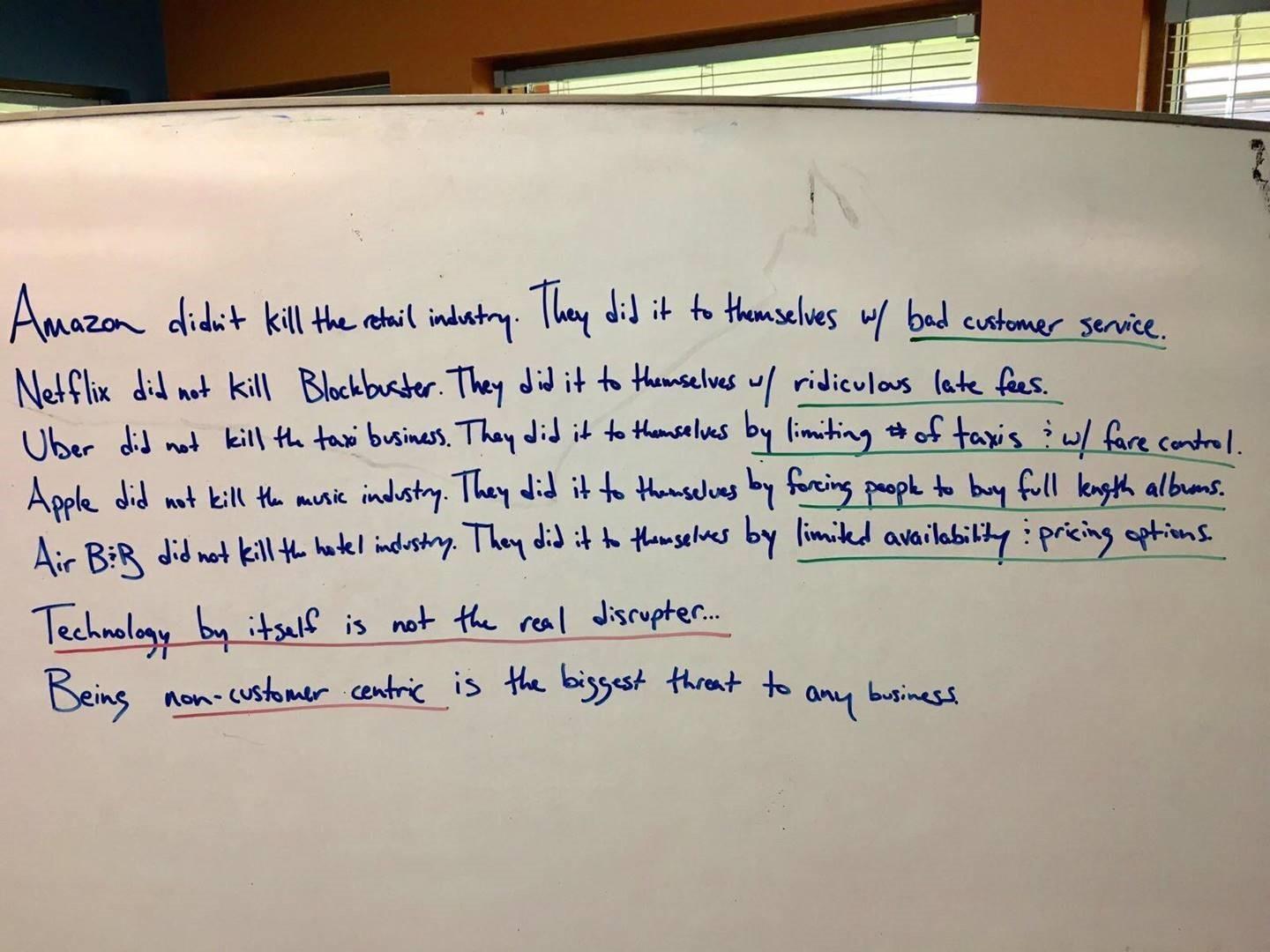
The observation is correct. It travels because it punctures a comfortable myth: that incumbents simply lost a technology race, and that if they had only moved faster on digital, they would have survived. That is not what happened.
But the popular reading stops at the wrong place. Most people take away “be more customer-centric” and move on. That is the easy half of the lesson. The harder half asks a sharper question. What specific operating-model choice did each company make? And why did they protect it even as it damaged the customer relationship?
That is where the real analysis lives. Each case has a specific answer, and the answers matter for anyone running a business today.
Why Did Blockbuster Really Fail?
Blockbuster’s late fees were not an accident. They were a designed revenue stream. Late charges were a meaningful portion of the company’s income, significant enough to be a structural feature of the financial model, not a side effect. The fees were not a bug in the customer experience. They were a feature of the operating architecture.
Netflix launched a flat monthly subscription with no late fees. That was not a technology innovation. It was the removal of a specific friction that Blockbuster had built and protected. Blockbuster ran internal tests on eliminating fees. Franchisee contracts and revenue models made a full reversal nearly impossible without restructuring the economics of the entire business. The problem was not that Blockbuster failed to notice. It was that the late fee was baked into how the company made money. Removing it meant dismantling the model. That is what made the response so difficult.
How Did Taxi Companies Protect Themselves Into Irrelevance?
Taxi medallion systems were supply control by design. In most major cities, the number of operating licenses was capped by regulation. Operators had invested substantially in those medallions. The cap kept supply limited and fares elevated. The medallion was a valuable asset because of that enforced scarcity.
When Uber and Lyft launched, they did not bring a superior transportation technology. They brought GPS routing, dynamic pricing, and driver supply that bypassed the medallion system entirely. Taxi operators responded through regulators, not through product improvement. That made complete sense given what they were protecting. A flexible, dynamic-supply model would have collapsed the value of the medallion asset. The rigidity was not stubbornness for its own sake. It was the business model. Defending the business model meant defending the friction.
What Did Music Labels Choose When They Chose the Album Bundle?
Music labels bundled albums to protect margin. For decades, buying one song meant buying a full album. That was not how listeners thought about music. It was how labels structured their economics. The CD format made bundling easy to enforce and financially rewarding. Labels understood that consumers wanted individual tracks. They chose the bundle anyway.
When Apple launched the iTunes Store in 2003 and offered individual songs at $0.99, it did not introduce exotic technology. It sold the unit consumers actually wanted, at a price they found fair (as documented in Walter Isaacson’s biography of Steve Jobs and extensively in music industry histories of that period). Labels resisted and then accepted the model only because the alternative was losing digital distribution entirely. The album bundle had been the economic architecture. Selling individual tracks meant rebuilding that architecture from scratch. The choice to defend the bundle was rational under the old model. It made the transition catastrophic.
How Did Hotel Yield Management Create the Airbnb Opening?
Hotels built sophisticated yield management systems. Those systems used demand forecasting to set prices and control room availability, with the goal of maximizing revenue per available room. For guests, the result was opaque pricing, rigid cancellation policies, and minimum-stay requirements at peak times. The system was optimized for the hotel’s revenue model, not the guest’s decision process.
Airbnb hosts had none of that infrastructure. Pricing was simple. Cancellation terms were set by the individual host. Guests could message the owner directly. The asset was different, yes. But so was the friction level. Hotels understood their systems created guest frustration. The yield management infrastructure was too embedded, too valuable, and too tied to brand-standard consistency to dismantle for a simpler experience. The operational rigidity was the guest experience problem, and the guest experience problem was the opening.
What Does “Every System Is Perfectly Designed for Its Results” Actually Mean Here?
There is a principle in operations that explains what happened in each of these cases. W. Edwards Deming stated it plainly: every system is perfectly designed to produce exactly the results it currently produces.
As described in detail in the Mechanisms, Not Intentions analysis of this principle, the insight is diagnostic rather than critical. The incumbents were not broken companies run by careless people. They were well-designed organizations producing exactly what their systems were designed to produce. Blockbuster’s system was optimized for late-fee revenue. It worked. The taxi system was designed to protect medallion value. It worked. The label system was built to sell bundles. It worked. The hotel system was built to maximize revenue per available room. It worked.
The customer resentment was not a malfunction. It was an output. The system produced it alongside the revenue, as a designed consequence of the architecture. When a disruptor arrived with a model that removed the friction, customers chose the frictionless option. The incumbent could not easily follow, because following meant dismantling the model that produced the money.
That is the correct reading of the LinkedIn list. Not “be more customer-centric.” Build an operating model that does not systematically produce customer resentment as a designed output. Those are very different instructions, and only one of them tells you where to look.
What Is the Founder-Led Version of Blockbuster’s Late Fee?
The Blockbuster story is easy to analyze from a distance. It is much harder to recognize from the inside of your own business.
A founder-led business has its own version of the late fee. It is the approval step that exists to protect a metric instead of the customer. It is the workaround the entire team knows about and silently routes around, because raising it feels like criticizing the founder’s original design. It is the pricing structure that made sense two years ago and now creates friction at every sales conversation. It is the founder sitting in the middle of every decision, not because that is the fastest path to a good answer, but because the system was never built to route decisions anywhere else.
These are not complaints about bad people or bad intentions. A system set up this way is producing exactly what it was designed to produce. Operational symptoms compound quietly. Nobody needs to arrive with a disruptive model to cause damage. The operating model is already producing the result. The question is only whether you see it before someone else removes the friction for your customers.
The transition from founder-led to systems-led is partly about talent and partly about process. But it starts with an honest read of what the operating model is actually producing, not what you intend it to produce. The cost of not making that read compounds. The real cost of operational drag shows up in the places you are least watching, and later than you expect.
What Does an Operator Do With This Analysis?
The operator’s job is to find self-inflicted friction before it becomes the opening someone else walks through. That means reading the operating model as it actually runs, not as the org chart says it runs.
A fractional operating partner embeds long enough to see which outputs the system is actually producing. They look for the processes the team works around, the approval steps that protect a number over an outcome, the policies that create friction as a designed feature of the revenue model. Then they build the mechanisms to remove it before the gap widens. The goal is not to redesign everything. It is to find the late fee in the operating model and address it while you still have the option.
The Forge Assessment is that diagnostic. Thirty days to map what the operating model is actually producing across decisions, handoffs, pricing, and process. The output is a ranked list of where the model is protecting a number instead of the outcome, and a 90-day roadmap to address the highest-impact gaps. The investment is $6,500. That is a fraction of the cost of defending the model until someone else removes its friction for your customers.
What is operational rigidity and why does it cause business disruption?
Operational rigidity is when an organization’s processes, pricing, or policies become fixed around a revenue model rather than customer outcomes. It causes disruption not by slowing the company down but by systematically producing customer friction as a designed output. When a competitor removes that friction, customers move. The incumbent often cannot follow without dismantling the model that produced the revenue in the first place.
How did Blockbuster’s operating model create the opening Netflix walked through?
Blockbuster built late fees into its financial architecture as a significant revenue stream. When Netflix launched a flat subscription with no late fees, it removed that specific friction. Blockbuster tested eliminating fees but franchisee contracts and revenue models made it structurally difficult. The problem was not awareness. It was that removing the friction meant restructuring the entire economic model of the business.
What is the small-business equivalent of Blockbuster’s late-fee model?
In a founder-led business, the equivalent is any normalized friction the team works around silently: an approval step that protects a metric instead of a customer, a pricing structure that creates drag at every sales conversation, or a founder at the center of every decision because the system was never built to route decisions anywhere else. The operating model is producing those results as a designed output, not a flaw.
How does the Deming principle explain why incumbents could not adapt quickly?
W. Edwards Deming’s principle, applied in the Mechanisms, Not Intentions framework, holds that every system is perfectly designed to produce exactly the results it currently produces. The incumbents’ customer friction was not a bug. It was a designed output of the revenue model. Changing it required changing the model, which is structurally difficult when the friction is also the source of margin or asset value.
What is the Forge Assessment and how does it surface self-inflicted operational friction?
The Forge Assessment is a 30-day operational diagnostic delivered by a fractional operating partner. It maps how the business actually operates across decisions, handoffs, pricing, and process, and identifies where the operating model is producing friction as a designed output rather than an accident. The result is a ranked 90-day roadmap. Investment is $6,500. Details at How the Forge Assessment Works.
Ready to find out where your operating model is protecting a number instead of the outcome? The Forge Assessment is the 30-day diagnostic that maps it. $6,500. A ranked roadmap at the end. Book a discovery call →
Jason Bonito is the founder of Crucible76, a fractional operating partner practice helping scaling businesses find and remove the self-inflicted friction before someone else does. DATA · DECISIONS · GROWTH.